Thursday, April 29, 2010

Fair Dinkim, you don't understand

Well, for those of you that don't know, I'm studying to be a teacher and this week I've been at a school "observing" classes before I take over in a couple of weeks. I'll be teaching for a whole month, 2 classes (that doesn't seem like a lot, but considering I've still got assignments and my actual paying job to concern myself with, that's plenty).

I'll be teaching a whole unit on a novel and today the class picked up the novel, Tomorrow when the War Began (lots of moans and groans and 'Miss, I don't like to read'). It's truly an Australian  novel, with language and everything... the class had to collect a dictionary of Australian slang words. Here's a trailer for the movie that's coming out in September.


This actually made me think (*gasp*), would people from other places find a novel with local slang harder to read, or would they be able to fit a definition to the word based on the sentence? I've actually had problems in previous novels, especially since most of my readers are from England or America, where they didn't understand what I was trying to convey.

The hardest time is when that single word changes meaning in different languages. One example was Jumper. This:

Changed to:

It doesn't seem like much, but the person reviewing the chapter couldn't understand why my MC was grabbing jumper just in case it was cold.

Slang, just like dialects in dialogue, can sometimes hinder a person's understanding of the story (seriously, there were even some words/phrases that I had never heard of and I'm Australian), but it can also used to convey the setting. So, how do you choose what slang to use in an MS?
  • Don't use FAD words
    Words that are current at the moment might become outdated before your novel is even published. Such terms as Cool, Bad, Slamming, Rad, etc could mean something totally different so your story will feel outdated, or worse, your readers won't be able to understand it.
  • Use if adds to setting/era
    You can't deny it, slang terms makes up a culture and such terms are necessary to indicate the time or place that the novel is set (this is especially important if you're writing a historical novel since they didn't speak the same way we do now).
  • Make sure readers can get definition from within the sentence
    If a reader has to spend a long time trying to decode the slang that's in a story, then the reader won't want to continue reading (I know I won't... I barely like trying to decipher long-winded fantasy names at the best of times). Simple and sweet is the best way to utilise slang terms, don't go for the hard sayings that no one has ever heard of.
  • If it helps, it helps
    Above all, don't try to eliminate all culture and background. The way we all speak is based on the words we've grown up with. If you try to eliminate all slang words, then you're eliminating a lot of personality from the novel. Just think about what you're saying before you put it in.
So, how do you handle slang in your novels? Do you try not to put it in to make the writing universal? Or do you don't even think about it (and sorry about that because you'll probably start to from now on)?

And on a final note, here's a little quick for you. Can you answer these questions on Australian slang?
  1. Get your "thongs" on
  2. Rack off
  3. I feel safe with the "bum bag"

Wednesday, April 28, 2010

Wind-down Wednesday

To start off with the post today, I would like to thank Lydia Kang for giving me the awesomesauce award.

I would like to pass it on to:

Okay, now that's out of the way I've decided to change up Wind-down Wednesday's and now it will feature contests and other interesting and amusing links that I've seen out there in the blogosphere.

To start off with, there are numerous contests available out there at the moment:
  • http://writinginthewilderness.blogspot.com/2010/04/tgif-and-contest.html - The prizes that are up for grabs are three gift cards. One for $20 and two for $15 from either Amazon, Barnes and Noble, or Borders, winners choice. All you have to do is comment on the post to enter, plus there's other ways of getting more entries.
  • Steph Bowe has a contest over at her blog. She's having a massive book give away with lots of great books up on offer. All you have to do is fill in a simple entry form (piece of cake).
  • Noelle Nolan has a contest called the 150 follower contest and it's not going to close until she has 150 followers. Up for grabs is a $10 Amazon gift card and all you have to do is follow her, plus there's extra entries available as well.
  • Steena & Stina is having a contest for a query critique. All you have to do to enter is be a follower as well as fill in an entry form.
Interesting links for the week:
  • For anyone who likes horoscopes, Paperback Writer has created one especially for writers.
  • Here is a post, over at Hyperbole and a Half, that screams they are irritated by the word "alot" appearing in Manuscripts.
 And just to wrap up another perfect day, here is a trailer of the movie Beastly. It looks killer, and now I just want to read the book before going and watching it:


    Tuesday, April 27, 2010

    The Need to Capture Your Attention


    So, yesterday we looked at beginnings that have been overdone and are probably not the best way to capture the readers attention, but what makes a good beginning?

    I wish there was some easy way to answer this. Every writer always searches for the perfect way to start a story. They search for that one perfect line that will dangle the bait in front of the reader's eyes just waiting for the chance to hook them and reel them into the rest of the story. I could just make a list of what makes good openings, but the truth is that the best openings are unique to each novel.

    Instead, I'm going to pick several great openings (hey, they've been voted upon) and analyse what makes them so great. And, just because I'm mean, I'm not going to tell you where the quotes come from. So, here's a challenge, can you guess where these openers come from?

    1. Call me Ishmael.
      What is it about this line that everyone loves? It's simple, plain and introduces the reader to the character straight away. The conversational way it is written just invites the reader to snuggle in to a nice and cosy chair and follow Ishmael on his journey.

    2. It was a bright cold day in April, and the clocks were striking thirteen.
      At the first glance, doesn't this just look like it's breaking a big NoNo. It starts by addressing what the day looks like, but then the reader is drawn in by the unusual. Since when do clocks strike 13?

    3. In my younger and more vulnerable years my father gave me some advice that I've been turning over in my mind ever since.
      This sentence introduces the character first up. It is not trying to do anything fancy, just letting the character letting the character mull over what advice he was given. Through the use of "younger" and "vulnerable" it's suggesting that the character has made some developments before the story has even started, now the reader wants to know about the character and follow them on this journey.

    4. We went to the moon to have fun, but the moon turned out to completely suck.
      This is a fun little sentence, which also draws the readers attention. It is taking something unusual that the reader can only hope to imagine, after all, we can't really go to the moon now, can we?

    5. Mr. and Mrs. Dursley, of number four, Privet Drive, were proud to say that they were perfectly normal, thank you very much. They were the last people you'd expect to be involved in anything strange or mysterious, because they just didn't hold with such nonsense.
      This sentence introduces some of the characters of the novel. It also introduces the normal world. It also hints that something has happened to alter this normal world and you want to find out what "strange" or "mysterious" thing has happened.

    6. Far out in the uncharted backwaters of the unfashionable end of the western spiral of the Galaxy lies a small unregarded yellow sun.
      This sentence introduces the setting. It's also introducing the unusual.

    7. When Mr Bilbo Baggins of Bag End announced that he would shortly be celebrating his eleventyifirst birthday with a party of special magnificence, there was much talk and excitement in Hobbiton.This passage introduces the character. It also has a fun voice and introduces the language.

    8. The man in black fled across the desert, and the gunslinger followed.Short and sweet. It introduces a couple of characters. By not giving too much description or names of the characters, it creates an aura of mystery. Who are these characters? The reader has to read on to find out.

    9. When I wake up, the other side of the bed is cold. My fingers stretch out, seeking Prim’s warmth but finding only the rough canvas cover of the mattress. She must have had bad dreams and climbed in with our mother. Of course she did. This is the day of the reaping.
      This passage introduces the character (also another that could be said is bad by having the character waking up, but it works). It introduces her word, and the reader wants to find out what's special about this day. What is the reaping?

    10. My mother used to tell me about the ocean. She said there was a place where there was nothing but water as far as you could see and that it was always moving, rushing toward you and then away. She once showed me a picture that she said was my great-great-great-grandmother standing in the ocean as a child. It has been years since, and the picture was lost to fire long ago, but I remember it, faded and worn. A little girl surrounded by nothingness.
      This introduces the character as well as eluding to the conditions as to which the character is living. This is done by saying that the character only knows of such a normal setting as the ocean. Every reader should know what an ocean is, so the writer is grabbing the reader's attention while doing some good world building.

    So, by looking at the ten passages above can you see some pattern forming as to what makes up great first sentences? It starts with a "C" and ends with a "haracter". That's right. Most of the above start with a character. If you take pages to introduce the character then the reader has no one with which to identify with.

    Another element that could add interest to the first sentence is through the hint of the unusual. I was more drawn to the sentences that gave some clue that not everything was as it should be. There was something different with the world that is being created, or there was a hint that something was about to happen.


    How did you go with picking where the first lines comes from? Can you think of any other good examples? Or, do you disagree with some of these on the list?

    Monday, April 26, 2010

    We have to begin somewhere

    Last week I focused on can make good or bad endings. Well, even though you need to make the reader want to return for the next book, it's even more important to capture their interest to want to read the book to begin with.

    Beginnings can either make or break the readers view of the story. It is said that the average person takes five seconds to form an opinion on a person or place after the first view, the same can be said with books. Readers often know what they're in for within the first five pages, so grabbing their attention from the get go has to be the main objective of any writer.

    Instead of focusing on what makes a good beginning, let's have a look at some of the train wrecks misguided stories I've seen, and let's see if you've done any of these or have been tempted to.

    1. It was all a dream...
      I bet you can probably name several books that start like this. The writer definitely captures the attention of the reader, drawing them inside the events of a fast paced action sequence. You're sitting on the edge of the seat, wondering whether the hero will make it through (yes, it's only the first chapter, but still they could die... it's been done), and then... and then... the character wakes up.

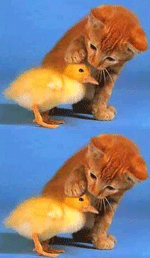
      All the events that the reader's been following turns out to be nothing more than a dream. So, everything that you've learnt up until this point is worthless and will never be brought up again... so please enjoy this cute animation of a kitten with a duck.


    2. The silly little prologue that makes no sense with the rest of the book and never comes back...
      Just like the dream, but is slightly - somehow - relevant. Some fraction of it may (or may not) appear somewhere throughout the story at which point you'll find out that it was not as near impressive as it was made out to be.

      These beginnings only aim to set up a hook and reel the reader in with promises of big character drama towards the end of the book. Often they are actually a foreshadow of the events that will take place near the end, so when you finally do get up to that point, the writer can head in a totally different direction just so long as they make a brief mention that this happens.

    3. Phone book disguised as introduction
      Once upon a time in the land of Fousuold, in the Barony of Reefutal, King Juujikli consulted his beloved advisor Suolaoud in the matter of Luernua who was betrothed to Juljike after the tragic death of Wearouljdo four Faaulke moons ago...

      This kind of beginning often happen in fantasy stories and is as easy on the reader as swallowing a banjo. Long lists of places, people and customs are rattled off in quick succession like a machine gun loaded with tape worms. If anyone finds any logical reason for mentioning this many people, places, and made up words that require the reader to collect them and create their own dictionary all in the first paragraph please let me know, I am dying to find out.

    4. How I spent my Summer Vacation
      Dramatic event that happened long ago in the retelling of the MC's past. Here, the reader is led to believe that this event had a serious effect upon the characters and plot. In truth it is just an effort to create a backstory that won't be able to fit into the bulk of the book so it is shoehorned at the beginning.

      Yes, the event may prove to be important and may have altered the character (much like being dropped into a vat of radioactive chemical waste would), the true reason it can't be fit into the rest of the book is because it's practically useless to the story that's being told.

    5. THE PROPHECY
      Bmp...bmp...bmp!

      So, your MC is the "Chosen One". For messaihic figure press 1... for deadly battle of intertwined foes press 2... for the only person in the world to stop Armagedon press 3... for dramatic tale of true love press 4... for character getting up, going through an utterly pointless life and dying in a meaningless, undignified death at the end press 5... thank you and have a nice day.

      Prophecy. The easiest way for a writer to join together the tangled threads of a plot, especially if the character has no true purpose and is just ambling through the story. Occassionally this style can be done well, if planned ahead.

      These beginnings usually take the form of Prologues written in fancy italics and doesn't even involve the MC or anyone of specific nature... although most of the times it is the bad guy learning the prophecy that starts the story.

    Don't get me wrong, some of these beginnings can be beneficial. Some times they're just not. I can say that I've been guilty of using a couple of these every now and again... believe it or not, I rewrote the entire beginning of my MS to eliminate the dream sequence opening. Have you ever done any of these beginnings? Or, are there other beginnings that you see that you hate, on the other hand, do you like some of these beginnings (because it's okay if you do)?

    Friday, April 23, 2010

    Review: Princess for Hire

    Princess for Hire by Lindsey Leavitt

    Synopsis (From back cover): When a flawlessly dressed woman steps out of an iridescent bubble and wants to know, like, now if you’d like to become a substitute princess, do you
               a) run
               b) faint
               c) say Yes!

    For Desi Bascomb, who’s been longing for a bit of glamour in her Idaho life, the choice is a definite C–that is, once she can stop pinching herself. As her new agent Meredith explains, Desi has a rare magical ability: when she applies the ancient Egyptian formula “Royal Rouge,” she can transform temporarily into the exact lookalike of any princess who needs her subbing services. Dream come true, right?

    Well, Desi soon discovers that subbing involves a lot more than wearing a tiara and waving at cameras. Like, what do you do when a bullying older sister puts you on a heinous crash diet? Or when the tribal villagers gather to watch you perform a ceremonial dance you don’t know? Or when a princess’s conflicted sweetheart shows up to break things off–and you know she would want you to change his mind?

    In this hilarious, winning debut, one girl’s dream of glamour transforms into something bigger: the desire to make a positive impact. And an impact

    I liked the idea of Princess for Hire ever since I heard it mentioned in the debut authors list for 2010, after all, what little girl didn't want to be a princess? Desi is a fun character to follow, and you can immediately tell that she's bored with her life and wants a change, but she didn't think that change would come from a want ad in the newspaper or woman travelling in giant bubbles.

    The story is fast paced and I was there wishing Desi would succeed as she subbed for each princess. The story is a bit predictable in parts, but it's a good one to curl up in bed and read for pure enjoyment. The story idea itself was an original take and I loved some of the gadgets that are present that mixes magic with science.

    Leavitt has a fun story here, which I can't wait until the next one.

    Cover: The American cover is what originally grabbed my attention (the one at the top). It has the elegance of royalty which is what the story is about, but it also hints as to what is involved in the story. I was stoked to find this story available in Australia, but it was released with the UK cover which I didn't like as much. The cover emphasised a cartoon version of the story, even though the images depict more of what happens in the story.  
    Plot: 4/5 stars
    Ending: 4/5 stars
    US Cover: 4/5 stars
    UK Cover: 3/5 stars
    Overall: 4/5 stars
    Recommend:  Princess Diaries by Meg Cabot

    Debut Author Challenge: #4 of 12

    Thursday, April 22, 2010

    I Can't Believe it's the Ending

    Well, we looked at endings that should be stayed away from, but that doesn't actually help decide what is actually a good way to end a story, after all, every story is different (if they weren't then we would all be very boring people).

    Each ending should be distinct and different. You don't want readers to turn around and say that the ending you worked so hard on is actually too cliche or predictable. I know that if the ending really let me down then I don't want to pick up the next book (unless the rest of the story was good). I've even wanted to walk out of movies ten minutes before they ended because the ending really went downhill (they should have finished the movie ten minutes before the actual end and it would have been better).

    So, today I've looked extensively at the endings of movies and books that I've absolutely adored. Most of them can be classified under the following:

    1. Life Goes On Ending
      The main obstacle has been overcome, the hero either wins or loses and life can continue. But life being life, means things are not neat and tidy. The writer actually acknowledges things are still progressing, even if the main challenge that they were trying to overcome has being defeated. Often these endings lead to another clue being revealed or gives a hint that there's still more mysteries left to solve, which dangles a little bit of bait in the readers face and whispers in their ear, "You have to wait till the next book to find out." As long as the main goal of the story is wrapped up, then it's okay to leave the reader wanting more.

    2. Unexpected Twist
      These are the ending where the writer throws in something that the reader is not prepared for. Don't get me wrong, the writer has to do a lot of set up, throwing hints all the way through the story so that it doesn't seem too random. These are the stories I love the most, and these mostly come from psychological thrillers (well, they're the ones I watch the most).

      Here, you are following the character and all the clues points to "the butler" as the guilty bad guy, but did you notice the crooked picture or a stain on the carpet that was mentioned in the detail that you just passed off as the writer getting carried away with description. And then, the ending comes and you're wrong. The one you thought was really behind it was really trying to protect the MC while that distant character that was always in the background of every scene was the real villain.

    3. Method in the Madness Ending
      If done well, I really like these endings. These endings are where the (dare I say it...) the bad guy wins. These endings have to be taken with care and there has to be a reason why the character that the reader/viewer has staked a good chunk of time following, getting to know and experiencing all the ups and downs on this journey would lose. I've seen some smashing movies where the bad guy wins (these are usually psychological thrillers again, or sometimes even horrors) and they were fantastic, but on the other end I've seen some where the bad guy wins and there's no survivors because the writer wanted it to be gory and gross (these mainly are horror/slasher films).

      I haven't read any books where the bad guy actually does win (mainly because I stick with YA a lot of the time and it doesn't seem to fit with that genre), but when dealing with these types of ending the writer has to be careful about not kicking the MC when they're down, but to either show there's no hope of winning or be leading up to an Unexpected Twist which has been carefully plotted out.

      And no, killing your character off at the end of the novel because he's pissed you off doesn't count as having the villain win.

    4. Time Loop
      Oh, I love these sort of endings, so I had to throw it in. These stories always involves some form of time travel or prophecy. This is the endings where it is revealed that the character cannot escape their fate and things are destined to repeat, no matter what the character does to try and stop it. This can also be classified as "Self-fulfilling Prophecy" where the character knows their fate (or even the villain) and they set out to stop it from happening, usually setting the exact things in motion, so no matter what they do, they are destined to repeat the same mistakes over and over and over again.

     I think when I'm writing my story I always aim for the unexpected twist (even though that often fails and I'm just left with a life goes on type). So, do you know where your stories are going to end before you get there? Or, do you just write and hope the character will end up in a logical but different place.

    Wednesday, April 21, 2010

    Wind-down Wednesday

    Billy Joe, Singer and songwriter


    I just love musicals (yeah, I know. I'm sappy like that). And, I felt this song was a fantastic song to represent what writers are like. I like to believe you learn more from rejections and mistakes than you do if you got that "yes" (even though that one "yes" would be absolutely fantastic and I would take it over a rejection any day). If you can get back up, learn from the mistake and try again, that will only make you stronger. We writers are all survivors who will pursue through all conditions (dare I say it... through sleet and rain) until we achieve our goals.

    Just remember that it's okay to scream every now and again. If you're embarrassed to out in public, then go to a theme park and ride a thrill ride... that'll give you the opportunity. And, don't forget to give yourself at least some time to relax and catch your breath. Hope everyone's Wednesday is going good.
     
    Blog Design by Imagination Designs all images from the Her Lullaby kit by Irene Alexeeva